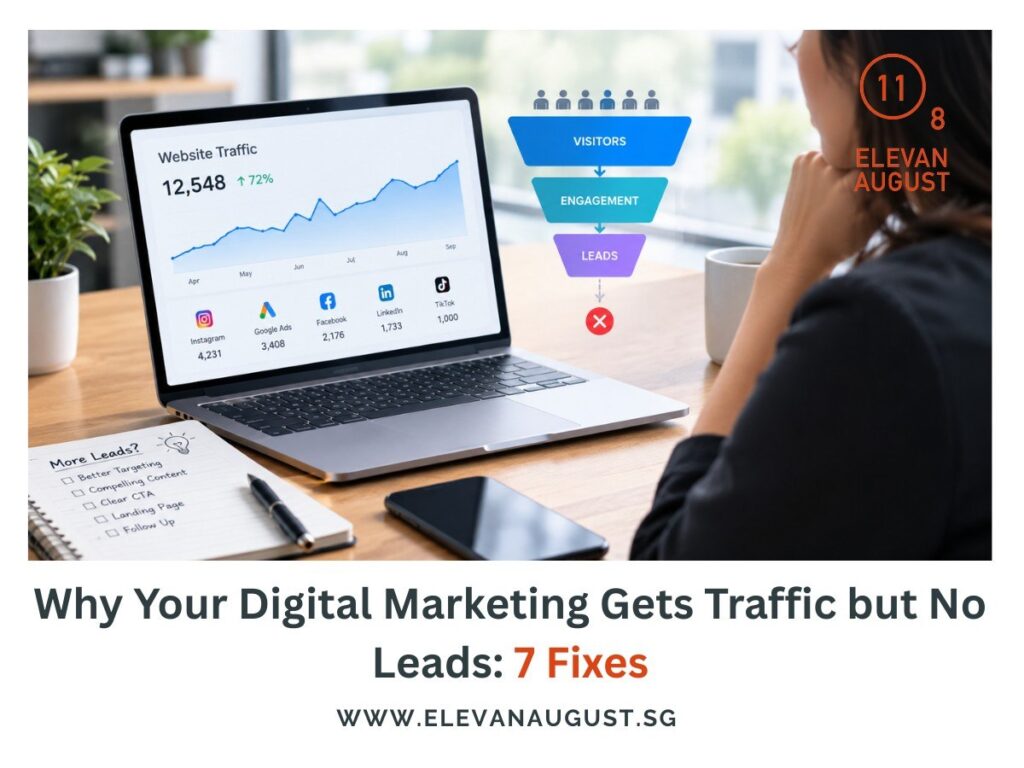
More traffic can make a marketing report look healthy while sales sees little change. The problem often sits somewhere in the quality of the traffic, the offer, the landing page, or what happens after someone enquires.
Throwing more money at acquisition rarely fixes those gaps. A better response is to work out what is blocking visitors from becoming useful leads.
Here are seven fixes worth looking at.
1. Cut traffic that has little buying intent
A large share of your traffic may come from people who were never close to buying.
An article ranking for “what is payroll software” can bring thousands of visits to a SaaS company. A page targeting “payroll software pricing Singapore” reaches a much smaller group, but those visitors have a clearer reason to compare providers.
Look at which pages and queries generate the traffic increase. If most of the growth comes from educational content, treat it as awareness traffic and judge it on that basis.
The same applies to paid campaigns. Google Ads Search Terms can show which actual searches are spending your budget. Remove terms that repeatedly attract the wrong type of visitor.
2. Fix the gap between the click and the landing page
A visitor should see the same offer after the click that convinced them to click in the first place.
If your ad promotes “corporate sales training in Singapore” and lands on a general homepage, the visitor now has to find the service again. Each extra decision adds friction.
The fix is simple: compare the ad or search result with the landing-page headline, offer, and CTA.
Someone arriving for a specific service should land on a page about that service. Someone clicking a pricing message should see pricing context quickly.
A strong traffic source can still produce weak leads when the landing page changes the subject.
3. Make the offer easier to understand
Traffic can reach the right page and still stall when the offer feels vague.
“Grow your business with our marketing solutions” gives the visitor very little to work with. A clearer offer explains who the service is for, what problem it handles, and what the customer receives.
This becomes especially important for service businesses where people compare several providers before enquiring.
Review your main commercial pages and remove copy that could belong to any competitor. Replace it with concrete details such as scope, process, timelines, deliverables, pricing ranges, or what happens after someone gets in touch.
People convert faster when they can understand what they are buying.
4. Reduce the effort required to enquire
A strong offer can lose people at the form.
Long forms, unnecessary required fields, awkward mobile layouts, slow booking tools, and unclear error messages all create small points of resistance. Several of them together can cut lead volume quickly.
Try the full enquiry process yourself on a phone. Start from the landing page, complete every field, submit the form, and check what happens afterwards.
Pay close attention to questions that serve your internal process more than the customer. Sales can collect extra detail later.
For most lead-generation pages, the form only needs enough information to start a useful conversation.
5. Answer the questions people ask before they buy
Repeated sales questions often expose gaps on the website.
If prospects regularly ask about cost, contract length, turnaround time, who handles the account, or what the service includes, those questions probably deserve space on the page.
This is more useful than adding another generic testimonial section.
A buyer considering a S$5,000 service needs enough detail to understand the commitment before sharing contact information. The exact information will vary by business, but the principle stays the same: remove uncertainty around the purchase.
Your sales team already knows where that uncertainty tends to appear.
6. Stop forcing every visitor into the same CTA
“Book a consultation” makes sense for someone ready to speak with sales. It gives an early-stage visitor a much bigger commitment.
Different pages can support different next actions. An educational article may lead naturally to a comparison page, pricing guide, calculator, case study, or service page. A commercial page can ask for a demo, quote, booking, or consultation.
This gives your digital marketing traffic somewhere useful to go even when the visitor needs more information before enquiring.
The CTA should match the decision the page has helped the reader make.
7. Measure qualified leads instead of form fills
A form submission only tells you that someone contacted the business. Sales still has to decide whether the person is worth pursuing. This distinction can completely change how you judge a campaign.
One channel may produce 60 enquiries and only 10 qualified leads. Another may generate 25 enquiries and send 15 serious opportunities to sales.
The second channel has fewer conversions on paper and a much stronger business result.
Track what happens after the form: qualified lead, sales conversation, proposal, and customer. Once you see those stages, you can tell which traffic sources are actually helping revenue.
Final Thoughts
Traffic becomes useful when the people arriving have a clear path towards buying. If enquiries stay flat, the fix may sit in audience quality, the offer, the page, the conversion path, or the way leads are measured.
At Elevan August, a digital marketing agency in Singapore, our work covers SEO, paid media, websites, and lead generation, so we look at these parts together when traffic and business results start moving in different directions.
If your website is attracting visitors without producing enough qualified enquiries, our team can help you identify where the gaps are. As a lead generation company in Singapore, we can help you improve the areas that are limiting conversions and work towards generating more qualified enquiries.