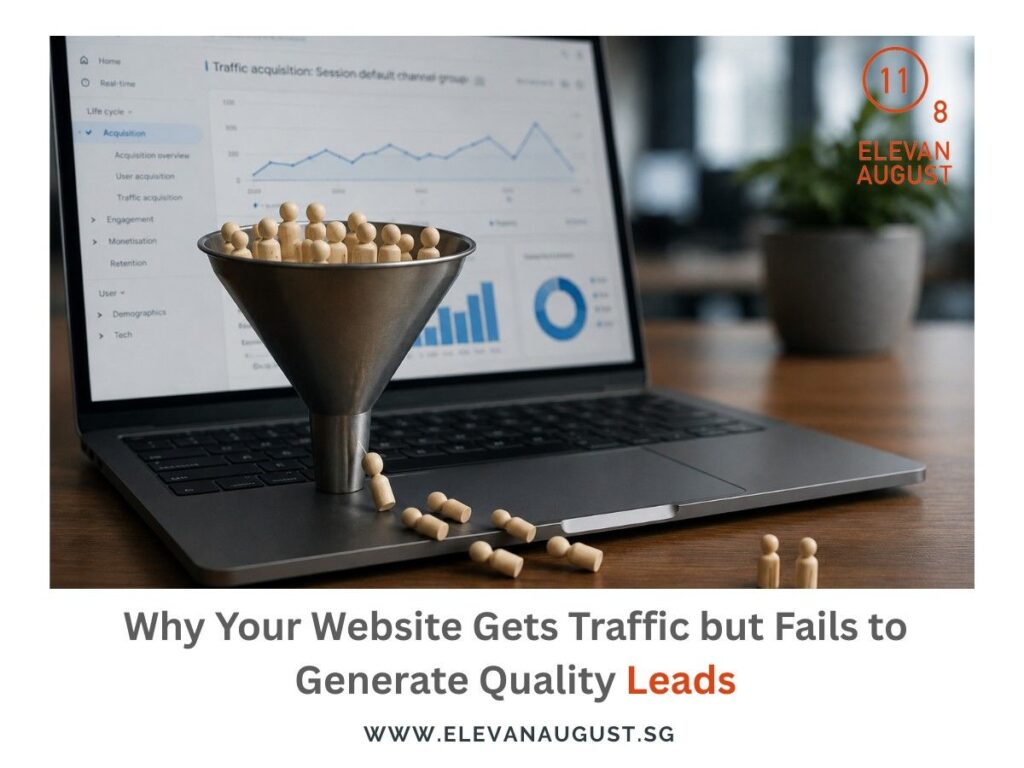
Traffic can feel encouraging at first. You see visitors coming in, pages getting viewed, and campaigns pulling clicks from search, ads, or social.
Then the real question shows up when enquiries stay quiet, and sales conversations stay thin. That gap usually points to a website issue rather than a visibility issue.
Here are five common reasons that gap shows up:
1. Traffic quality shapes lead quality from the very first click
Traffic turns into leads when the visitor arrives with the right intent, and that part gets overlooked more often than most teams expect.
A person reading an educational blog post usually wants clarity, while a person searching for pricing, case studies, or service comparisons sits much closer to action.
Google and Bain found that 92% of B2B buyers already have a shortlist before the buying process begins, which means your website often meets people after they have already formed early preferences.
If your page attracts broad curiosity while your form asks for immediate commitment, the gap between visitor intent and page expectation grows wider.
2. Your page needs to answer the buyer’s practical questions early
A visitor moves forward when the page reduces effort and clears up uncertainty in plain language. Many websites talk at length about services, yet leave a buyer guessing about the basics that matter in the first few seconds of evaluation.
A stronger page usually answers questions like these before the reader has to search around for them:
- What exactly will you do for me?
- Who is this service best suited for?
- What happens after I send an enquiry?
- What proof shows real results or experience?
- What makes this business worth shortlisting?
A page that handles those points well gives the reader a sense of direction, and that sense of direction often matters more than clever copy.
3. Trust signals carry more weight than polished wording
Leads grow when your website helps a visitor feel informed, steady, and ready for a next step. Pretty design can help, yet proof usually carries the heavier load, especially for services with higher cost, longer timelines, or a stronger need for confidence before contact.
A visitor often looks for a case study, a clear process, a testimonial that feels believable, or even a simple explanation of how work gets done.
Google’s B2B research also points to a buying journey shaped by independent digital research, which means your website often does part of the trust-building work before any human conversation begins.
4. Small friction points quietly weaken conversion momentum
Lead drop-off often comes from a cluster of minor obstacles rather than one dramatic flaw, and those small obstacles add up faster than many teams realize.
Unbounce’s benchmark data places the median landing page conversion rate at 6.6% across industries, which gives a useful reference point for reviewing page performance and spotting weak spots in the journey. Common blockers usually include points like these:
- A long form with too many fields
- A vague headline that delays clarity
- A mobile layout that feels cramped
- A slow page that drains attention
- A weak call to action that feels heavy
- A next step that stays unclear after form submission
Each one seems small on its own, yet together they create hesitation, and hesitation tends to cut momentum right when interest starts building.
5. The best websites guide the visitor forward in small, believable steps
Lead generation usually improves when the next step feels timely and easy to accept. A visitor who has just discovered your business may want to read a service page, scan a few client results, or get a clearer sense of how you work before reaching out.
Someone further along may feel ready to fill in a form or ask for a conversation straight away.
This is where many businesses take cues from lead generation companies Singapore, since strong pages tend to line up the message, proof, and next action with the reader’s level of intent. When that flow feels natural, enquiries tend to come in with more clarity and better fit.
Final Thoughts
Lead generation usually improves when your website removes guesswork and helps the visitor move forward with confidence.
Clear messaging, believable proof, and an easy next step often do more for enquiry volume than another push for extra clicks.
A lot of businesses spend heavily to bring people in, then leave the page to do too much on its own without enough support in the copy or structure.
If traffic is already coming in, a closer review of the user journey may open up more room for growth, and that same thinking continues to shape how we approach lead generation, websites, and paid campaigns at Elevan August. If you need help, get in touch with us today and talk to our experts.