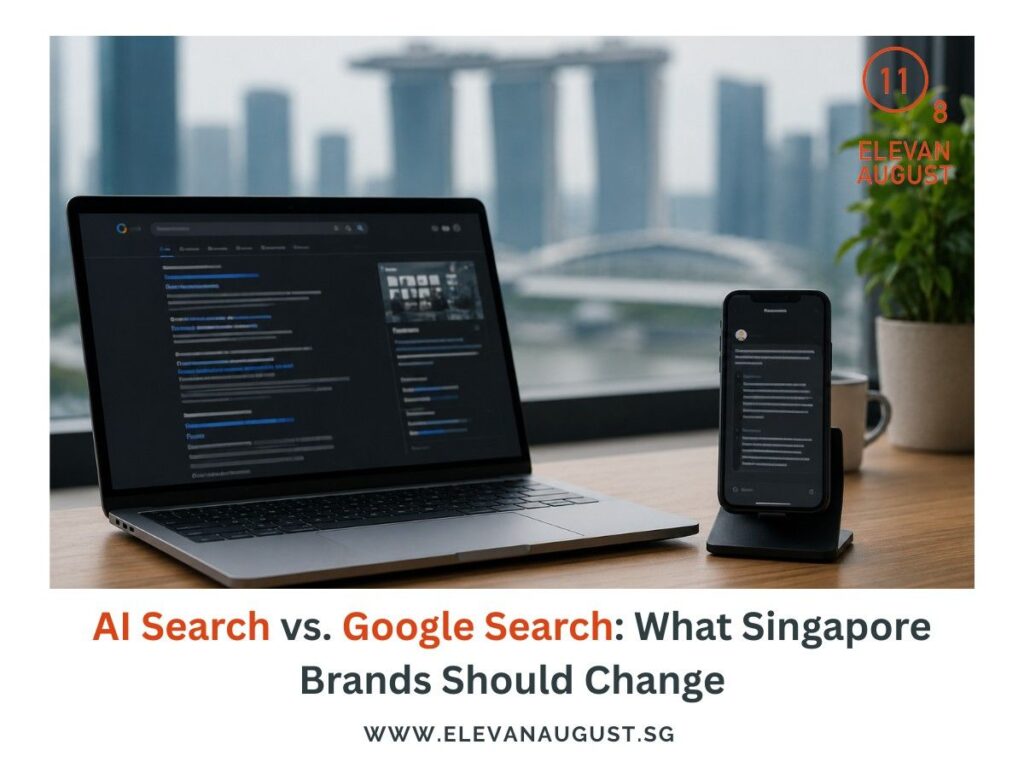
Search behaviour has become harder to read from one dashboard. A buyer may begin with an AI assistant, compare reviews on Google, and return later through a branded search.
The same decision now moves across generated answers, maps, organic results, and direct visits. The useful way to think about AI search vs. Google search is to see two forms of discovery feeding one customer journey.
Google now includes AI Overviews and AI Mode, bringing answer-led and link-led search closer together. Singapore brands therefore need to protect classic search visibility while improving the information AI systems can use. Here’s how:
1. Understand the role each search experience plays
Google Search helps people compare options, explore local listings, read reviews, and choose which pages to open. AI search often compresses research into one response, drawing from several sources and supporting follow-up questions.
The distinction is behavioural rather than platform based because Google offers both classic results and generated answers. Your brand may shape the shortlist before a website visit appears in analytics, especially when an answer cites your page.
The website still needs to earn visits and supply enough context for a search system to represent the offer correctly. This means your visibility may carry value before the customer reaches your site, although the page remains central to evaluation and conversion.
2. Protect the pages that help customers decide
Strong Google foundations continue to support AI-led discovery because Google’s generative features draw from its Search index and core ranking systems.
Pages need to be crawlable, indexed, and eligible to appear with a search snippet before they can surface in AI Overviews or AI Mode.
Give extra attention to service, product, comparison, location, pricing, and contact pages. Each one should explain what you offer, who it suits, what affects cost or fit, and what the visitor can do next.
Internal links should lead clearly to those pages, while titles and headings should match their purpose.
Google also says Business Profiles and Merchant Center data can support visibility in generative responses and other Search results.
A useful review starts with the pages closest to an enquiry. Check whether the information remains current, whether important details appear prominently, and whether overlapping pages compete around the same customer need.
3. Publish source material that AI answers can use
Generic explainers give search systems little reason to associate the information with one particular brand. A stronger page contains material produced through your own work, research, or customer evidence.
Useful additions may include:
- Explain the factors that change pricing, delivery time, or suitability.
- Publish original findings, benchmarks, or recurring patterns from customer work.
- Show the method behind a result so readers can judge how it was reached.
- Add an expert view where common advice misses an important condition.
Keep the evidence close to the claim it supports and name the person or team responsible for it. ChatGPT Search can surface public webpages with links to sources, while OAI-SearchBot controls whether a site can appear in ChatGPT’s search features.
Review older content with the same standard. A page may rank for years while carrying outdated claims, weak examples, or figures that have lost their original context.
4. Keep brand and local information aligned
AI-generated answers and Google results may draw on different public references, so conflicting business information creates avoidable ambiguity.
Your website, Google Business Profile, directory listings, partner pages, and public company profiles should describe the business in compatible terms.
For Singapore brands, local details deserve a careful review. Keep the address, service area, opening hours, phone number, categories, and core service descriptions current wherever customers may encounter them.
Google says local results are shaped mainly by relevance, distance, and prominence. Complete profile information and genuine reviews help Google match a business with suitable local searches.
Consistency also helps customers compare what they see across different places. A service described one way on your website and another way on a business directory can create hesitation even when both versions remain technically accurate.
5. Make the website useful after the research stage
Visitors arriving after an AI-assisted search may already understand the basic category and common options. Your page can use that head start to help them evaluate fit and take a sensible next step.
Replace broad introductions with details that move the decision forward. Pricing ranges, selection criteria, process timelines, service boundaries, proof from completed work, and answers to commercial questions carry more value at this stage.
Forms should ask for information your team will use, mobile pages should keep key proof visible, and each call to action should match the page purpose. A comparison page may lead naturally to a consultation, while an educational guide may lead to a related service page.
This part of the journey deserves regular testing. Review where visitors pause, which pages lead to enquiries, and whether the promised next step matches what the page has helped them understand.
6. Measure the complete search journey
A useful report combines visibility, visits, and enquiries instead of separating AI search from Google Search.
Review organic traffic, generative AI impressions, branded searches, ChatGPT referrals, local profile actions, assisted conversions, and the pages that receive qualified leads.
Google’s dedicated Search Console reports show impressions from AI Overviews and AI Mode for eligible properties. ChatGPT referrals can also be identified in analytics when publishers receive visits from linked sources.
A monthly review can record the landing page, source, market, recent content change, and resulting enquiry. Over time, this reveals which pages support discovery and which ones influence evaluation.
Keep AI visibility figures beside wider commercial data rather than presenting them as a separate success metric. More appearances carry limited value when they come from the wrong market, surface an irrelevant page, or contribute little to enquiries.
Final Thoughts
Singapore brands gain more from treating AI search and Google Search as connected parts of one decision process.
The work involves keeping core pages visible, improving source material, maintaining accurate local information, and making every website visit more useful.
The best digital marketing agency in Singapore can help align those moving parts within one plan. Our work at Elevan August brings SEO, content, website design, paid media, and lead generation together, so your public information stays consistent and each channel supports a clear route towards enquiry.
Get in touch with us if your search strategy needs to account for both generated answers and traditional results.