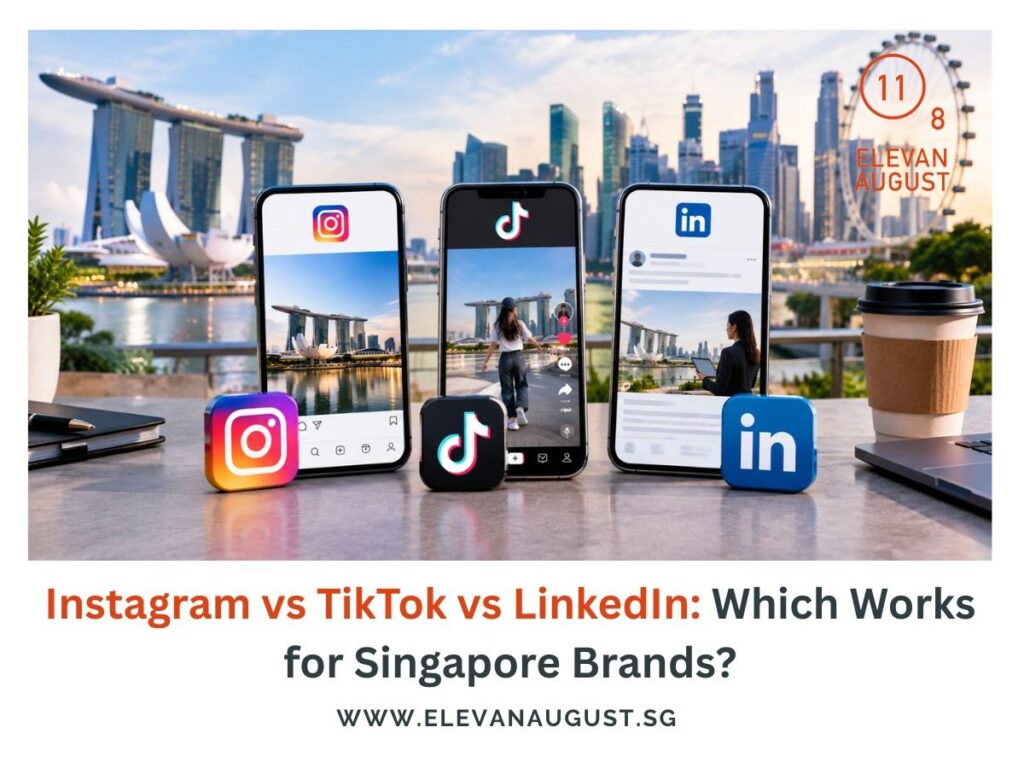
Instagram, TikTok and LinkedIn can all put your brand in front of a large audience in Singapore, but people open each platform for different reasons. Someone scrolling Instagram may be looking for places to eat or products to try, while a LinkedIn session is far more likely to happen in a work context.
This makes follower counts and total audience size a poor way to choose where your brand should spend its time. Your customer, product and the kind of attention you need give you a much better starting point.
Here’s how the three platforms compare for Singapore brands.
Audience size tells you less than you might expect
All three platforms have enough reach in Singapore to support serious marketing activity. NapoleonCat’s August 2026 data puts Instagram’s addressable audience at about 4.37 million users, with people aged 25 to 34 making up the largest group at 35.7%.
TikTok is hardly limited to teenagers either. DataReportal’s Digital 2026 Singapore report shows that TikTok’s advertising tools could reach 3.8 million Singapore users aged 18 and above in late 2025, equal to 75.4% of the adult population at the time.
LinkedIn appears even larger on paper. NapoleonCat’s August 2026 data shows around 5.52 million members, with 45.3% aged 25 to 34. Yet LinkedIn counts registered members, while Instagram and TikTok use different audience measures, so these numbers work poorly as a straight popularity ranking.
The better question is what your customer is doing once they open each app.
Instagram can carry people from discovery to decision
Instagram works especially well when customers want to look around before they buy. A Reel may be the first contact with your brand, but the decision can happen later after someone checks your profile, recent Stories, tagged posts, product photos, location details, or customer comments.
That behaviour suits categories where appearance and experience influence the sale. A restaurant can show the food and atmosphere. A fitness studio can show classes, trainers and member results. A fashion label can give people several ways to see how a product looks beyond a single campaign image.
The audience is broad enough to support that role in Singapore. DataReportal’s Digital 2026 Singapore report shows that Meta’s advertising tools could reach about 3.35 million Instagram users here in late 2025, equal to 65.5% of adults aged 18 and above. Meta’s reported ad reach also grew by 9.8% between October 2024 and October 2025.
For a visual consumer brand, the advantage comes from having discovery and evaluation happen in the same account. If people regularly want to see the product, place, or customer experience before taking action, Instagram gives you enough formats to support that decision without forcing every post to do the same job.
TikTok works when the content itself can spark interest
TikTok is strongest when your product gives people something interesting to watch before they have any reason to search for your brand. A demonstration, transformation, reaction, useful tip or entertaining take can introduce the product inside content that earns attention on its own.
A skincare company has an obvious advantage here. It can show how a product looks on the skin, answer a common question, compare application methods or let a creator document their experience without forcing every video into a conventional advertisement.
Singapore consumers already use TikTok for discovery. Vase.ai’s Singapore study found weekly TikTok use among 42% of respondents, while 24% said they first came across new brands there. Among people who named TikTok as their main platform, 45% tended to stop watching between 30 and 60 seconds.
The creative demand is higher, though. TikTok gives brands plenty of room to experiment, but a company with long approval cycles or very little material that works on video may struggle to keep the feed interesting.
LinkedIn makes more sense when your buyer is at work
LinkedIn has the clearest role when your customer is making a business or career decision. B2B software, consulting, recruitment, corporate training and professional services fit naturally because the person viewing the content arrives with their professional identity attached.
The platform also gives advertisers access to work-related targeting. LinkedIn lets campaigns reach audiences using signals such as company, industry, job role and seniority, which can make a relatively small group of relevant people more useful than a much larger consumer audience.
For example, a Singapore HR software company may care far more about reaching HR directors and operations leaders than collecting hundreds of thousands of general video views. A founder explaining a payroll problem, sharing original data or breaking down a customer issue also gives those buyers something useful before a sales conversation begins.
Audience size still supports the case. NapoleonCat reported 5.52 million LinkedIn members in Singapore in August 2026, including roughly 2.5 million people aged 25 to 34.
For B2B brands, LinkedIn usually deserves the first look because the surrounding context already matches the purchase.
Give each platform a different role
Using more than one platform can make sense when each one handles a different part of the job. A restaurant might use Instagram to show its food, space and customer experience throughout the week, then turn to TikTok when there’s a strong video concept that could reach people beyond its usual audience.
A B2B software company may organise things very differently. LinkedIn could carry founder posts, product education and customer stories, while Instagram supports hiring, company culture or event coverage.
Vase.ai’s Singapore survey also found that people spread their media time across several platforms, with no single platform accounting for more than a quarter of respondents when asked where they spent the most time.
For your team, this means each account needs a reason to exist. Once that role is clear, it becomes easier to decide where more time, creative effort and paid budget should go.
Final Thoughts
The better platform is usually the one that matches the moment when your customer is most open to discovering, checking, or considering your brand. Instagram can help people look around and build confidence, TikTok can put a product in front of someone before they were actively searching, and LinkedIn can reach buyers while they’re already thinking in a work context.
That also explains why copying the same content across all three tends to produce weak results. Each platform gives you a different kind of attention, so the content needs to earn that attention in a different way.
In the social media marketing Singapore work we handle at Elevan August, we look first at where the buying decision is happening and what role each channel can realistically play. If you’re unsure where your brand should focus, we can help you compare the options and decide where your time and budget are more likely to pay off. Get in touch with us today.