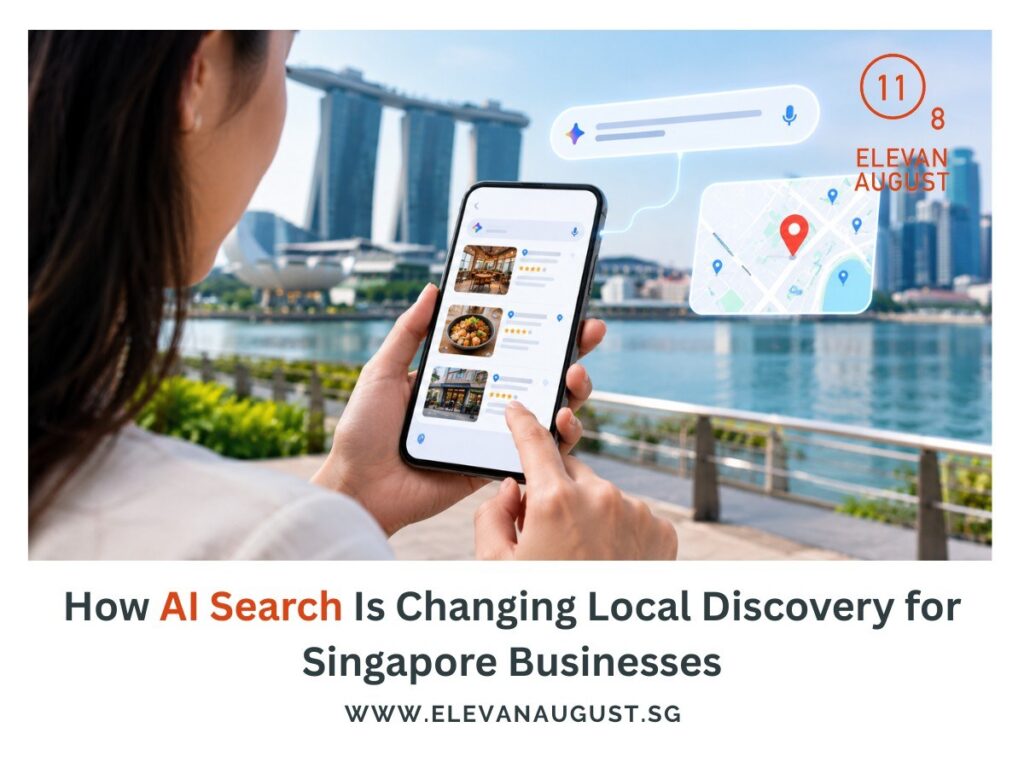
Someone looking for a restaurant, clinic, gym, or home service in Singapore can now ask a much more specific question than they would type into a traditional search box. Google AI Mode and ChatGPT can factor in location, preferences, context, and follow-up questions before suggesting places.
That changes what local discovery looks like for businesses. Ranking for a broad local keyword still has value, but more searches now start with detailed questions about whether a place actually fits what someone needs.
Here’s what Singapore businesses should understand as AI search becomes part of local discovery.
Local searches are becoming far more specific
AI search lets people describe the situation behind the search instead of reducing everything to a short keyword.
Someone can ask Google for “a quiet restaurant around Tanjong Pagar for six people with vegetarian options” or ask ChatGPT for a gym nearby that opens early and offers personal training. Follow-up questions can then narrow the options further.
Google has built this behaviour into AI Mode and Maps. Its newer local AI features can answer detailed questions about places and, in some markets, help users take actions such as making restaurant reservations. Singapore is among the countries where AI Mode supports dining reservation assistance.
ChatGPT can also use approximate location, or more precise location when a user chooses to share it, to return relevant nearby businesses.
For local businesses, this means discovery can depend on much more than appearing for “dentist Singapore” or “cafe Orchard.”
Your Google Business Profile now feeds a wider discovery system
Accurate local business information has a bigger job when AI systems are helping people compare places.
Google says local listings can draw information from a business website, licensed third-party data, user contributions, Business Profile owners, and Google’s own interactions with a place.
Your address, opening hours, phone number, service area, category, photos, and other profile details therefore give Google more context about when your business may be relevant. Google still says traditional local results rely mainly on relevance, distance, and prominence, with complete and accurate Business Profile information helping it understand the business.
For a Singapore clinic that has moved from Novena to Orchard, for example, conflicting location information across its website and listings creates an obvious problem. AI search has several versions of the business to interpret.
Regular Business Profile housekeeping now supports both familiar local SEO and newer AI-driven discovery.
Reviews can answer questions that your business category cannot
Reviews contain the kind of detail people increasingly include in conversational local searches.
A restaurant category tells Google that you serve food. Customer reviews may reveal that the place works well for large groups, stays relatively quiet at lunch, has convenient parking nearby, or offers several vegetarian dishes.
Google says Ask Maps can draw on information from more than 300 million places and reviews from a community of more than 500 million contributors. It can use those details to respond to questions about factors such as atmosphere, food options, parking, and suitability for particular occasions.
The opportunity here is less about collecting a large pile of generic five-star reviews and more about receiving genuine reviews that describe the actual customer experience.
A detailed review can give an AI system useful evidence for a highly specific local query.
Your website needs to explain where and how you serve customers
A local website becomes more useful to AI search when it answers practical questions about the business.
A cleaning company that serves the whole of Singapore could clearly explain its service areas, types of properties covered, booking process, operating hours, and any location-specific conditions. A dental clinic may have separate information about its location, nearby MRT station, appointment options, and treatments available at that branch.
Google says its local listings can use publicly available information crawled from official business websites. ChatGPT Search also uses web sources and allows publishers to make their websites eligible for discovery through OpenAI’s search crawler.
The practical question to ask is simple: could someone understand whether your business fits their local need from the information already available online?
Clear local details give search systems more useful material to work with.
Local discovery can now lead directly to an action
AI search is moving closer to what people want to do after choosing a business.
Google’s local AI features already combine recommendations with actions such as directions, reservations, and other place information. Ask Maps can also use context such as a user’s location and preferences when suggesting places.
This changes how businesses may want to judge local visibility. A website visit remains useful, but calls, direction requests, bookings, messages, and other interactions can tell a bigger story.
Google now allows businesses to connect Business Profile with GA4. The integration can bring interactions such as website clicks, calls, directions, messages, bookings, and menu clicks into Analytics.
For Singapore businesses, tracking those actions alongside organic traffic gives a more complete view of whether local discovery is producing real enquiries.
Final Thoughts
Local discovery is becoming more conversational because people can describe exactly what they need and let AI search narrow the options for them. For businesses, that puts more weight on accurate location data, useful website information, and the real experiences customers share online.
Traditional local SEO still supports much of this foundation, while AI search adds another way for people to discover and compare nearby businesses.
Our SEO work at Elevan August helps businesses strengthen how they appear across search and make it easier for potential customers to find them. As an SEO agency Singapore businesses can rely on, we help improve local visibility as AI search becomes a bigger part of discovery. If you want to improve your local visibility, get in touch with us today.